UV Water Purification: How It Works and When It Makes Sense
Clean drinking water remains an indispensable foundation of public health, yet microscopic pathogens routinely threaten private wells, aging municipal conduits, and surface supplies. Among the diverse spectrum of treatment methodologies available today, ultraviolet disinfection occupies an exceptional position. It operates without altering water chemistry, introducing synthetic compounds, or generating hazardous disinfection byproducts. Understanding how germicidal wavelengths neutralize pathogenic threats enables property owners, facility engineers, and municipal managers to make informed capital investments.
Rather than functioning as a physical barrier like a sediment filter or a chemical oxidizer like chlorine, ultraviolet radiation acts through precise biophysical disruption. When integrated correctly into a comprehensive filtration train, it neutralizes biological hazards with near-total efficacy. However, ultraviolet energy is not an all-in-one remedy for every aquatic contaminant. Knowing both its capabilities and operational boundaries determines whether this technology represents the ideal safeguard for a specific water supply.
The Physics of Germicidal Ultraviolet Photolysis
Ultraviolet light occupies the electromagnetic spectrum between visible light and X-rays, spanning wavelengths from 100 to 400 nanometers. Photobiologists partition this spectrum into four discrete bands: UV-A (315–400 nm), UV-B (280–315 nm), UV-C (200–280 nm), and Vacuum UV (100–200 nm). The germicidal zone falls specifically within the UV-C band, displaying peak biocidal efficiency between 254 and 265 nanometers.
At these wavelengths, photons possess enough energy to penetrate the cellular membranes of microorganisms and be absorbed directly by nucleic acids. Microbial DNA and RNA consist of purine and pyrimidine base pairs arranged in precise sequences that dictate cellular reproduction and metabolic maintenance. When a pathogen absorbs a photon within the germicidal window, the photochemical event ruptures hydrogen bonds and induces cross-linking between adjacent pyrimidine bases, primarily thymine in DNA and uracil in RNA.
This molecular rearrangement forms covalent cyclobutane pyrimidine dimers. These structural lesions physically distort the double helix, stalling DNA polymerase and preventing normal transcription and replication. An organism rendered incapable of transcribing genetic instructions or replicating its genome cannot infect a host or proliferate inside a biological system. From an epidemiological and clinical perspective, an inactivated organism is biologically harmless.
Calculating Delivered UV Dose
The efficacy of germicidal photolysis depends strictly on the delivered ultraviolet dose, defined mathematically as radiant flux density multiplied by exposure duration:
Dose (mJ/cm² or J/m²) = Intensity (mW/cm²) × Retention Time (seconds)
System designers calibrate this dose according to the biological threshold of target pathogens. Standard residential and commercial certifications, such as NSF/ANSI Standard 55, define two primary dose categories:
- Class A Systems (Minimum 40 mJ/cm²): Engineered to disinfect water containing pathogen loads of microbial origin, including viruses, bacteria, and cryptosporidium oocysts, ensuring full sanitization of microbiologically unsafe water.
- Class B Systems (Minimum 16 mJ/cm²): Formulated as supplemental bactericidal treatment for microbiologically safe water supplies, primarily suppressing nuisance, non-pathogenic bacteria or safeguarding against intermittent distribution regrowth.
For municipal operators and property engineers striving for Surface Water Treatment Rules compliance, delivering validated germicidal doses ensures the multi-log inactivation of resilient waterborne threats without handling volatile chlorine gas.
Pathogen Susceptibility: Bacteria, Viruses, and Protozoan Cysts
Different microbial classes display dramatically diverse resistance profiles to ultraviolet photolysis based on cell wall composition, genome size, and internal enzymatic repair mechanisms. Evaluating these resistance profiles explains why ultraviolet technology excels precisely where traditional chemical methods falter.
Encysted Protozoa: Cryptosporidium and Giardia
For decades, municipal utilities struggled with waterborne outbreaks driven by Cryptosporidium parvum and Giardia lamblia. These protozoan parasites produce robust outer shells—oocysts and cysts—that resist conventional chlorine concentrations. Achieving a 3-log reduction of Cryptosporidium with free chlorine requires contact times and chemical concentrations that produce unacceptable levels of carcinogenic trihalomethanes and haloacetic acids.
Conversely, the thick protein walls of protozoan cysts offer minimal shielding against penetrating UV-C photons. Extensive research confirms that a modest dose of 10 to 12 mJ/cm² achieves greater than a 3-log (99.9%) inactivation of both Cryptosporidium and Giardia, establishing ultraviolet chambers as the undisputed gold standard for protozoan barrier protection.
Enteric Bacteria
Common vegetative bacteria such as Escherichia coli, Salmonella enterica, Legionella pneumophila, and Campylobacter jejuni present fragile cellular structures. Most bacterial species succumb rapidly to doses between 5 and 15 mJ/cm². In standard systems calibrated to deliver 30 to 40 mJ/cm², bacterial populations experience complete multi-log eradication.
Viruses and Spores
Enteric viruses, including rotavirus, norovirus, hepatitis A, and adenovirus, exhibit variable sensitivity. Double-stranded RNA and DNA viruses require higher energetic inputs due to their compact structural organization and lack of extensive hydration layers. Adenovirus, in particular, represents the benchmark pathogen for UV recalcitrance, requiring doses approaching 186 mJ/cm² to achieve a 4-log reduction. Because of this resilience, multi-barrier filtration or hybrid disinfection protocols often serve commercial facilities where virus mitigation is paramount.
Anatomy of an Industrial-Grade UV Reactor
A functional ultraviolet disinfection assembly consists of several specialized hydraulic and mechanical elements engineered to maximize fluid contact while protecting delicate electronic components:
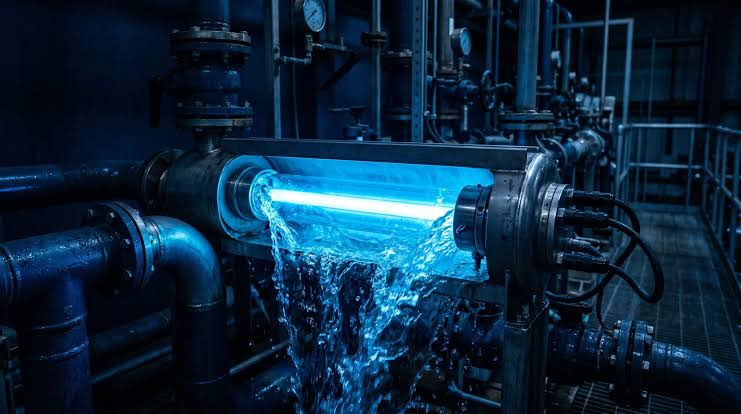
- Reactor Chamber: Typically constructed from passivated 304 or 316L stainless steel, the vessel houses the flow path. The interior surface is electropolished to reflect unabsorbed photons back through the fluid stream, increasing photon density and energetic efficiency.
- Germicidal Arc Lamp: The heart of the unit, usually a low-pressure or medium-pressure mercury vapor discharge lamp, generates spectral lines concentrated at 253.7 nanometers. Emerging solid-state UV-C light-emitting diodes (LEDs) are also transforming small-footprint applications with instant-on cycling and minimal heat output.
- High-Purity Quartz Sleeve: Standard borosilicate or soda-lime glass absorbs UV-C light entirely. Therefore, the lamp must be isolated inside a fused quartz sleeve exhibiting greater than 90% ultraviolet transmissivity at 254 nanometers.
- Ballast and Power Controller: Modern electronic ballasts regulate operating currents, safeguard against voltage spikes, and monitor real-time lamp output via integrated silicon carbide optical sensors.
If plumbing fixtures or internal distribution lines sustain biological colonization, a physical chamber cannot prevent downstream recontamination. Addressing complex configurations requires exploring our drinking water safety resources to plan comprehensive sanitization sweeps before reactor commissioning.
Water Quality Pre-Requisites and Transmittance Parameters
Ultraviolet disinfection relies entirely on light passing through a fluid medium without obstruction. If water contains suspended solids, dissolved minerals, or organic color compounds, photons scatter or absorb before striking microbial targets. A failure to condition raw water before UV processing undermines system performance.
Water quality specialists evaluate feed supplies across several strict chemical thresholds:
- UV Transmittance (UVT): UVT measures the percentage of 254 nm light that penetrates a one-centimeter path length of water. Municipal supplies often exceed 90% UVT, whereas raw well waters may register below 75%. Below 75% UVT, photons cannot reach the chamber perimeter, causing micro-pathogens to pass through unscathed.
- Turbidity: Suspended particulates act as physical shields, creating microscopic shadows behind which bacteria survive. Turbidity must measure strictly under 1.0 Nephelometric Turbidity Unit (NTU), ideally lower than 0.3 NTU. Pre-filtration using a 5-micron spun-polypropylene sediment cartridge is mandatory for all installations.
- Hardness (Calcium and Magnesium): High mineral hardness precipitates onto the heated quartz sleeve as insoluble carbonate scale, creating an opaque mineral barrier. Total hardness should remain below 7 grains per gallon (120 mg/L); harder water requires a protective ion-exchange softener ahead of the UV unit.
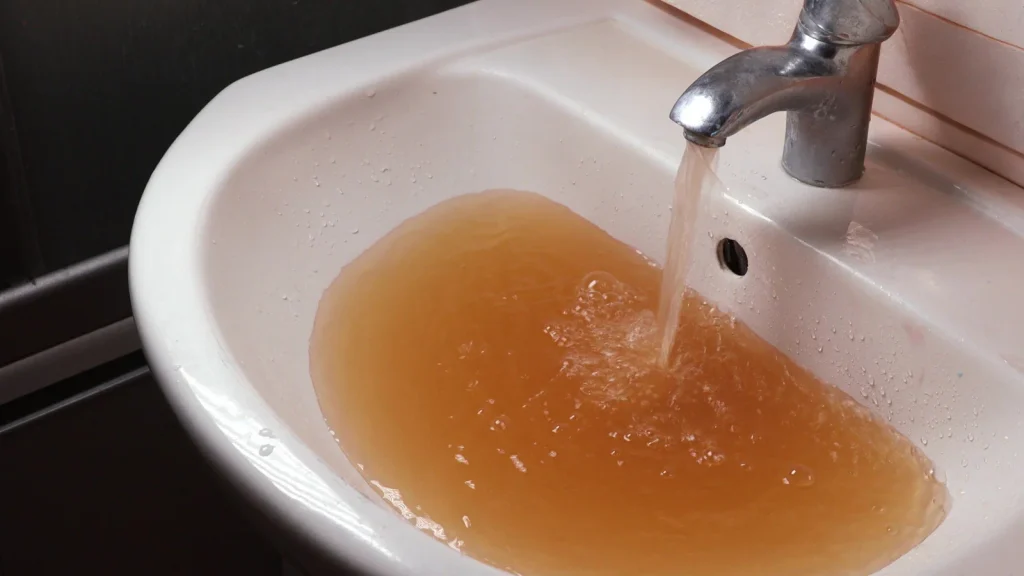
- Iron and Manganese: Iron levels exceeding 0.3 mg/L and manganese levels above 0.05 mg/L impart reddish-brown or black stains directly onto the quartz sleeve, rapidly blinding the lamp. Pre-treatment with oxidation filtration or catalytic carbon is essential when these transition metals are present.
- Tannins and Dissolved Organics: Decomposing vegetation introduces humic and fulvic acids that stain water pale yellow or tea-colored. Tannins strongly absorb UV-C photons, driving UVT down dramatically. Specialty anion resins or activated carbon blocks must strip tannins prior to irradiation.
Facility managers evaluating historic infrastructure often uncover complex contaminant profiles. In commercial properties, conducting an office building water testing in the Bronx ensures engineers identify elevated iron, sediment, or bacterial growth before selecting treatment hardware.
When UV Purification Makes Sense
Ultraviolet treatment offers unmistakable advantages across specific municipal, commercial, and residential environments where clean, low-maintenance biological protection is mandatory.
Private water wells represent the most common residential application. Unlike regulated public systems, private wells receive no baseline residual chlorination. Surface run-off, failing septic drain fields, and seasonal aquifer shifts routinely expose groundwater to fecal coliforms. Homeowners seeking reliable microbiological barriers without chlorination tastes or ongoing chemical purchases find ultraviolet equipment exceptionally practical.
Commercial facilities and food manufacturing plants rely on ultraviolet units to sanitize ingredients without adding chemical flavors. Breweries, pharmaceutical laboratories, and dairy processors use UV photolysis to control bio-burden without risking taste distortion or processing chemical residues. Similarly, off-grid cottages and rainwater collection systems implement UV disinfection downstream of atmospheric storage cisterns to neutralize airborne bacterial contamination.
In older urban structures, pipe integrity poses recurring challenges. Reviewing data on water quality in older buildings highlights how infrastructure disruptions, main breaks, and negative pressure transients pull biological contamination into internal risers. In such environments, point-of-entry ultraviolet systems provide dependable biological insurance.
When UV Purification Does Not Make Sense (And Alternatives)
Despite its remarkable germicidal capability, ultraviolet purification is not an appropriate standalone solution for every water quality problem. Recognizing what UV-C cannot accomplish prevents misplaced investments and lingering health risks.
Chemical and Heavy Metal Contamination
Ultraviolet photolysis exerts no mechanical filtration, chemical absorption, or ion-exchange capacity. It does not alter concentrations of:
- Heavy metals (lead, arsenic, copper, mercury, hexavalent chromium)
- Volatile organic compounds (benzene, toluene, perchloroethylene)
- Agricultural runoff (pesticides, herbicides, nitrates, nitrites)
- Per- and polyfluoroalkyl substances (PFAS, GenX)
- Total dissolved solids (salinity, sulfates, chlorides)
When chemical toxicity is the primary hazard, property owners must implement reverse osmosis, granular activated carbon, or specialty media instead of, or in addition to, UV lamps.
Radionuclides and Mineral Radiation
Naturally occurring radioactive elements present distinct health risks requiring specialized physical filtration. Facilities required to meet the EPA Radionuclides Rule for drinking water must deploy ion exchange or reverse osmosis to remove radium, uranium, and alpha/beta emitters, as ultraviolet light has zero impact on radioactive decay products.
Absence of Disinfection Residual
Ultraviolet photolysis is a point-in-time treatment. The moment water exits the stainless steel reactor, disinfection ceases. It leaves no chemical residual—such as free chlorine or chloramines—within the downstream plumbing. If the distribution pipework contains existing biofilm, scale, or bacterial growth, the treated water becomes re-contaminated before reaching the fixture. For extended municipal distribution networks or expansive commercial campuses, secondary chemical chlorination remains unavoidable.
Maintenance, System Monitoring, and Operational Protocols
A UV purification assembly functions as an active safety appliance, not a passive filter. Maintaining its structural integrity requires strict adherence to operational schedules:
Standard low-pressure mercury lamps provide an effective operating life of approximately 9,000 hours, equivalent to 375 days of continuous service. Although the lamp may emit visible blue light past this window, the generation of germicidal 254 nm photons decays significantly due to mercury exhaustion and internal solarization of the lamp envelope. Lamps must be replaced annually regardless of visual status.
Quartz sleeves require physical inspection and manual cleaning every six to twelve months. Scale buildup can be dissolved using mild food-grade acids such as citric acid or vinegar. If a sleeve develops permanent scratches, etching, or mineral crystallization, it must be replaced immediately to prevent photon attenuation.
To guard against sudden water contamination during a power disruption, systems should incorporate a normally closed solenoid valve tied directly to the ballast. If the lamp fails or power drops, the valve closes automatically, arresting unsterilized water before it enters the building. For additional troubleshooting procedures, consulting our water testing and safety FAQ provides rapid answers for common alarm triggers and flow interruptions.
Emergency Disinfection and Contingency Protocols
When extreme environmental incidents occur—such as regional flooding, hurricanes, or deep freeze bursts—power grids fail alongside water utility lines. Because ultraviolet reactors require constant electrical current, unpowered units leave properties vulnerable to biological incursions.
During catastrophic utility disruptions, facility engineers must follow established EPA emergency disinfection procedures, utilizing rolling thermal boils or calibrated sodium hypochlorite additions until electrical systems and pre-filtration arrays return to operational status. Property owners uncertain about the condition of their plumbing following an environmental shock should contact us to conduct comprehensive post-event microbiological testing.
Exploring specialized analytical guides across our water quality blog articles offers continuous updates on evolving filtration standards, regional water quality assessments, and cutting-edge sensor technology. Ultraviolet photolysis remains one of the most elegant, chemically benign, and energetically efficient methods for destroying waterborne pathogens. When installed with proper pre-treatment and monitored diligently, it delivers dependable, clean, and biologically secure water for residential, commercial, and industrial facilities alike.